In brief
- Biochar can influence nutrient retention, phosphorus availability, soil acidity and water conditions.
- It is not automatically a substitute for nitrogen, phosphorus, potassium or other nutrients removed in harvest.
- Some studies report improved nutrient availability or crop response; others show neutral or context-dependent effects.
- The realistic goal is more efficient, balanced and biologically supported nutrition, followed by evidence-based adjustment.
Dependency and requirement are different
Indian agriculture has strong reasons to improve fertilizer efficiency: farmer cost, public subsidy, nutrient imbalance and environmental losses. But the phrase “reduce chemical fertilizer dependency” can be misunderstood as “crops no longer need mineral nutrients.” Plants still need essential elements, and harvested grain, fruit or biomass removes nutrients from the field.
Dependency refers to how effectively the farming system retains, cycles and supplies those nutrients—and whether repeated applications compensate for weak soil function or avoidable losses. Better soil management may allow nutrients to be used more efficiently. It does not remove the need for nutrient accounting.
Where biochar may help
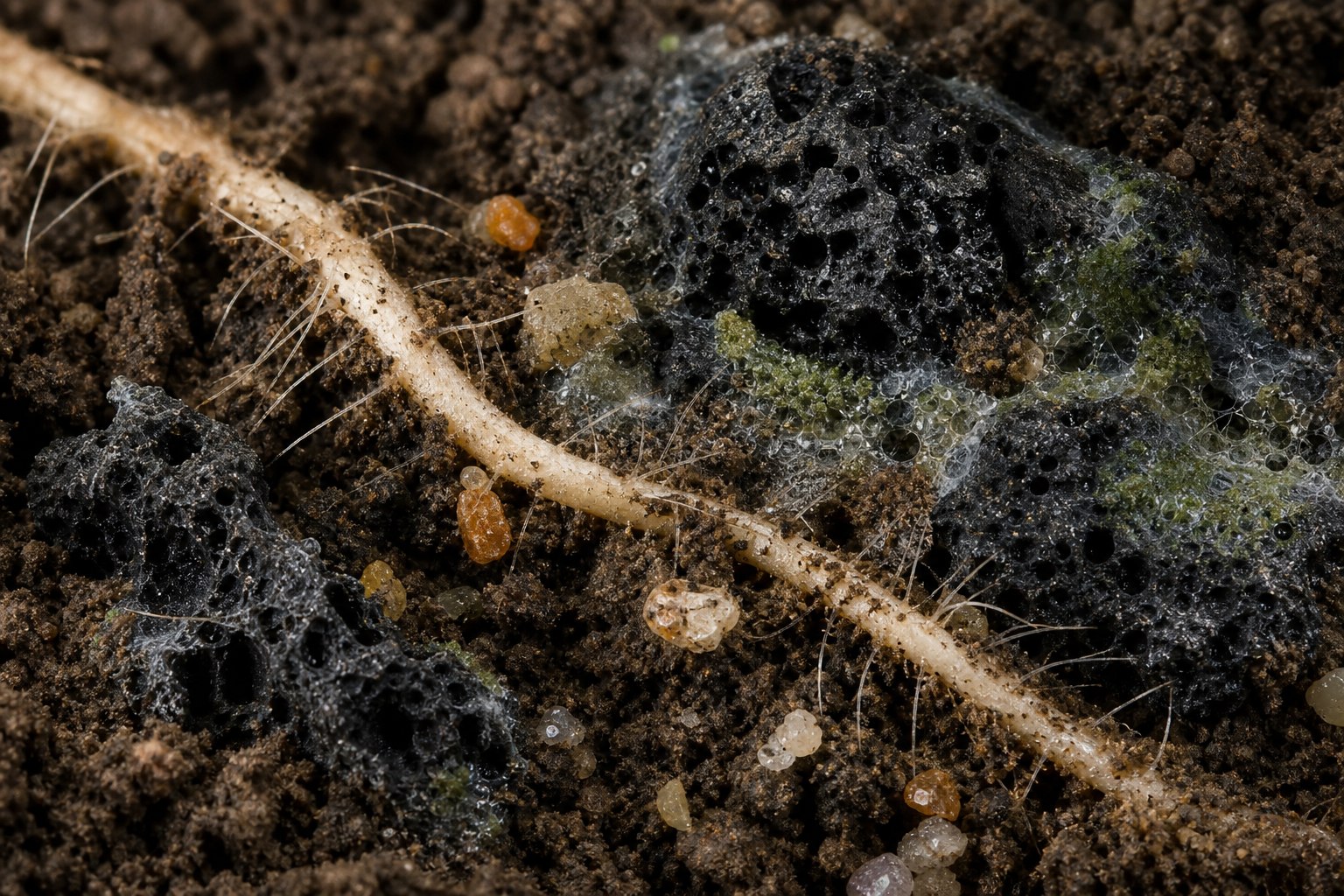
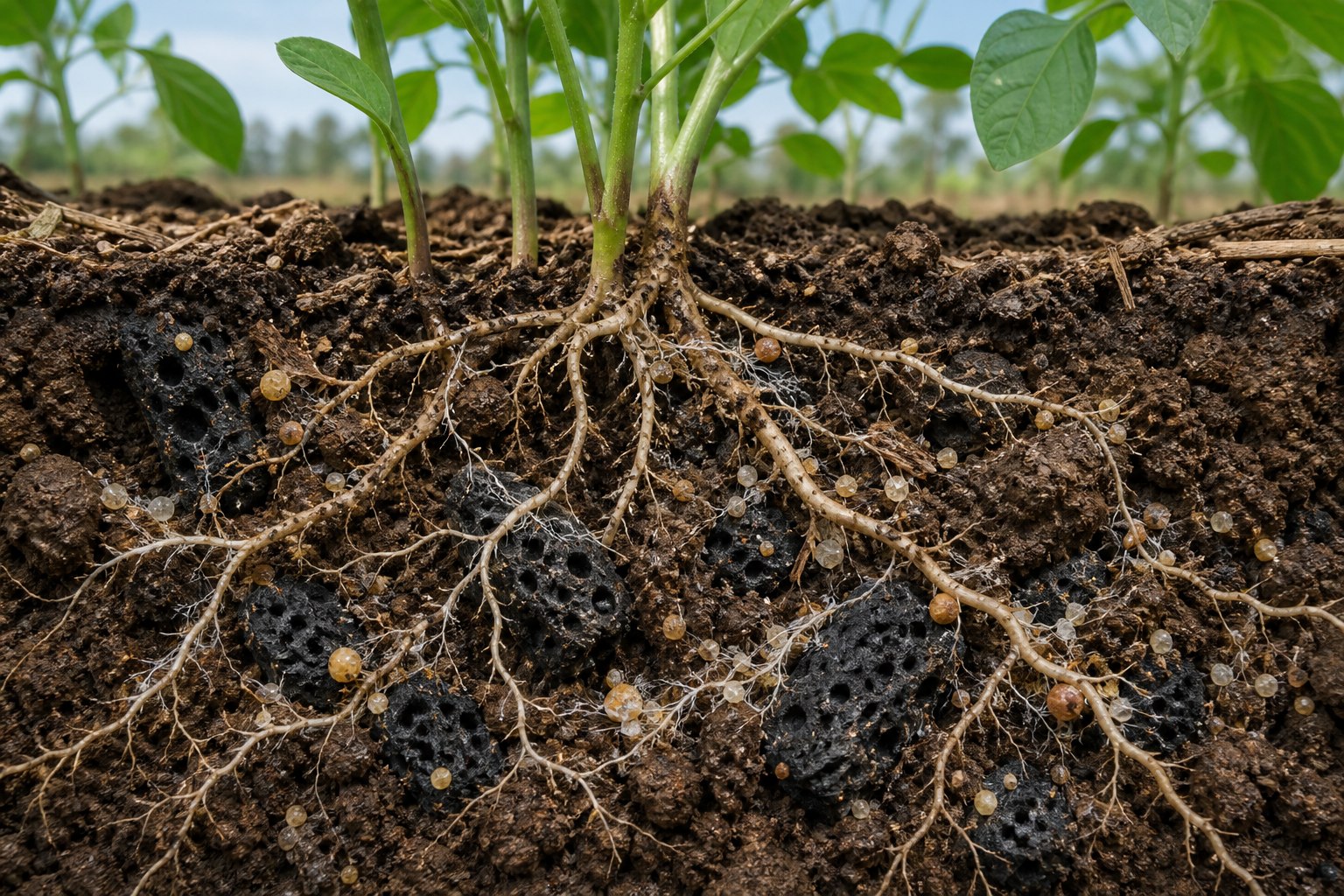
Biochar surfaces can interact with ions and organic molecules. Depending on its properties, it may influence cation exchange, pH, water retention and the movement of nutrients. Meta-analyses have found increases in available phosphorus across many experiments, while nitrogen responses are more variable. Biochar combined with organic fertilizer can behave differently from biochar used alone.
The same evidence also warns against universal recommendations. Feedstock, production temperature, carbon-to-nitrogen ratio, soil texture, soil pH, application rate and duration all influence results. An alkaline biochar in acidic soil creates a different situation from the same material in an alkaline soil.
Where biology fits
Microorganisms participate in nutrient transformations and root interactions. Mycorrhizal fungi can provide a pathway for phosphorus uptake, while other microbial processes influence nitrogen and micronutrients. Supporting these processes may improve access to nutrients already present in soil or organic inputs.
Yet biological activity cannot correct every deficiency. If a required element is absent or continually exported from the farm, biology cannot manufacture it. Integrated nutrient management therefore combines soil testing, appropriate nutrient sources, organic matter, roots, water management and biological processes.
The credible objective is not zero fertilizer everywhere. It is the right nutrient, at the right amount, in a soil system that wastes less of it.
A safer pathway to reduction
Where a farmer or program wants to test reduced fertilizer use, the responsible pathway is:
- Establish a soil-test and management baseline.
- Identify which nutrient, rate or loss pathway is being addressed.
- Compare treatments, including a current-practice control.
- Keep other management factors as consistent as possible.
- Measure crop response, quality and economics—not only visual greenness.
- Observe more than one season where feasible.
- Reduce rates only when local evidence supports the decision.
Carbonify's position is that healthier soil should make nutrient use more intelligent. Biochar, biology and organic resources can be part of that transition, but they must be connected to balanced mineral nutrition and field evidence.